
Explained
Hernia mesh surgery explained
Almost every modern hernia repair uses a mesh. Here is what it is, why, and what it means for you.

Why stitching alone is usually not enough
A hernia is a gap in the muscular wall of the abdomen. The obvious repair — pull the edges together and stitch them — was the standard approach for a long time, and it has one significant weakness.
Stitching a gap closed puts the tissue under tension. Every cough, every lift, every strain pulls on that same line of stitches. Over time, tension is what makes a repair fail, and the hernia comes back.
Mesh solves this differently. Instead of pulling the edges together, a sheet of mesh is laid over or behind the defect and secured to healthy tissue around it. The load is spread across a wide area rather than concentrated at a single stitched line. This is what surgeons mean by a "tension-free" repair, and it is why recurrence is considerably less likely with mesh than without it.
What the mesh actually is
Patients often picture something rigid, like a metal plate. It is not.
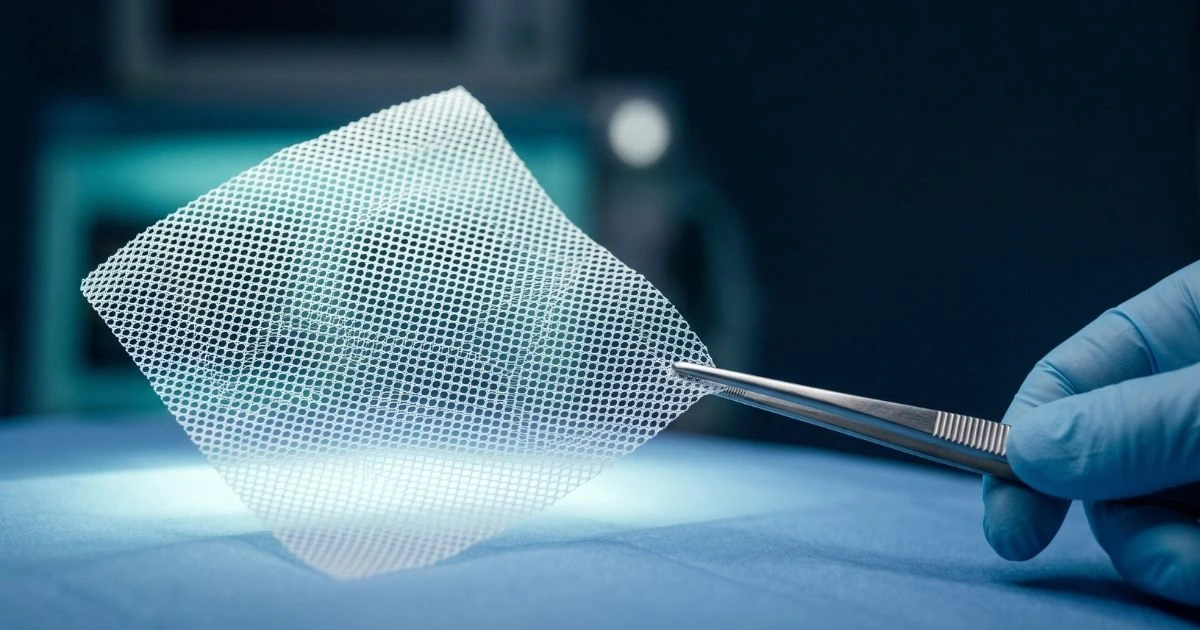
Surgical mesh is a thin, flexible sheet of woven synthetic material — most commonly polypropylene, the same family of medical-grade plastic used in surgical sutures for decades. It is soft, it moves with you, and once it settles you cannot feel it.
The important part is what happens after it is placed. Your own tissue grows through the pores of the mesh over the following weeks, incorporating it into the abdominal wall. The mesh does not hold the repair on its own — it acts as a scaffold, and the strength comes from your own healed tissue growing into it.
Meshes come in different weights, pore sizes and shapes, and some are designed for specific positions or for laparoscopic placement. Which one is used depends on where the hernia is, how large the defect is and how the repair is being done.
Where the mesh is placed
There is more than one correct answer, and the choice depends on the hernia and the approach.
- Onlay — on top of the repaired muscle layer, under the skin and fat.
- Inlay — bridging the gap itself, secured to its edges.
- Sublay / retromuscular — behind the muscle layer. Widely favoured for many abdominal wall hernias, because pressure from inside the abdomen presses the mesh against the wall rather than away from it.
- Intraperitoneal — inside the abdominal cavity, used in some laparoscopic repairs with meshes specially coated to sit safely against bowel.
This is one of the things worth asking your surgeon about, along with which approach — open or laparoscopic — is planned and why.
Common worries, answered plainly
- "Will my body reject it?" Mesh is not living tissue, so it is not rejected the way a transplanted organ can be. The body responds by growing tissue into it, which is exactly what is wanted.
- "Will it set off airport scanners?" No. It is not metallic.
- "Can I have an MRI?" Yes. Standard hernia mesh does not prevent MRI scanning.
- "Will I feel it?" Some patients notice a firm area or mild pulling for a few weeks while healing. Most cannot feel it at all once healed.
- "Does it need replacing?" No. It is designed to stay permanently.
- "I have read about mesh problems online." Complications are possible with any implant — infection, chronic discomfort or, rarely, the need to remove it. These are uncommon, and much of what circulates online relates to mesh used in entirely different operations, not hernia repair. If you have specific concerns, raise them before surgery rather than after.
What makes a repair last
The mesh does a great deal, but not everything. What you do in the weeks after surgery matters, because that is when your tissue is growing into it.
- Stop smoking. It impairs healing and causes coughing, which strains the repair. This is the single most useful thing many patients can do.
- Avoid constipation. Straining puts direct pressure on a fresh repair. Fibre, fluids and, if needed, a stool softener.
- Treat a chronic cough.
- Return to heavy work gradually, and at the time your discharge advice specifies — not when you feel fine, which is usually earlier.
- Manage your weight. Excess abdominal weight keeps constant pressure on the repair.
Mesh makes recurrence considerably less likely. It does not make it impossible, and no surgeon can promise that a hernia will never come back. What can be said is that a tension-free mesh repair, healed properly and looked after, is the most durable option currently available.
Common questions
Is mesh used in every hernia repair?
Almost every modern repair uses mesh, because tension-free repairs are more durable. There are exceptions — some very small hernias, some paediatric cases, and situations where infection makes an implant unwise.
Does the mesh stay in permanently?
Yes. Standard hernia mesh is designed to remain in place for life and to become incorporated into your own tissue.
Will mesh show up on airport security or block an MRI?
No to both. Hernia mesh is not metallic, so it does not trigger security scanners and it does not prevent MRI scanning.
Can a hernia come back after mesh repair?
It can, though it is much less likely than without mesh. Smoking, constipation, chronic cough, obesity and returning to heavy lifting too early all increase the risk.
Is mesh repair painful afterwards?
There is wound pain for the first few days, managed with medication. A small number of patients experience longer-lasting discomfort in the area; if that happens, tell your surgeon rather than waiting it out.
How long before the mesh is fully secure?
The scaffold works immediately, but the strength comes from tissue growing into it over the following weeks. That is precisely why the restrictions on heavy lifting exist during that period.
This article is general patient information and does not replace a consultation. If your symptoms are severe or getting worse, please see a doctor rather than relying on it.
Have a question about this?
Bring your reports to a consultation — often one visit settles it.