
Explained
Laparoscopic vs open surgery
Keyhole is not automatically better. Here is what genuinely differs, and when open surgery is the safer choice.

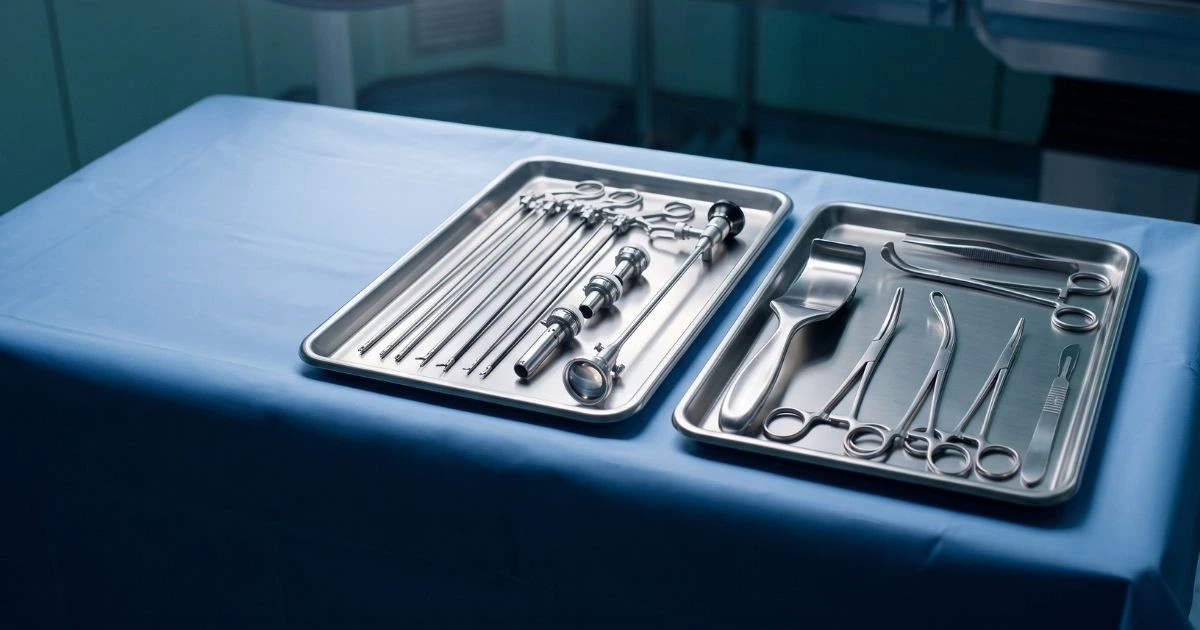
The difference is access, not the operation
This is the point most explanations miss, so it is worth stating first. Laparoscopic and open surgery are not two different operations. If your gallbladder needs to come out, it comes out either way. What differs is how the surgeon reaches it.
In open surgery, a single incision is made large enough to see and work through directly. In laparoscopic — keyhole — surgery, several small incisions are made instead. A camera goes through one, long instruments through the others, and the surgeon operates while watching a magnified view on a screen.
The organ removed, the repair performed, the anatomy respected — all the same. Only the route in is different.
What keyhole surgery usually gives you
- Less wound pain. Several small incisions hurt less than one long one, and patients typically need less pain medication.
- A shorter hospital stay. For many routine operations this is the single biggest practical difference.
- Faster return to normal activity. Most people get back to daily routine and work sooner.
- Smaller scars. Cosmetically better, and a smaller wound is less prone to infection.
- Fewer wound complications. Large incisions carry a higher risk of wound infection and of an incisional hernia developing later.
- A magnified view. The camera gives the surgeon a closer, brighter view of delicate structures than the naked eye does.
These are real advantages, and they are why keyhole surgery has become standard for many abdominal procedures. But they are advantages in the average case — not guarantees in yours.
When open surgery is the better choice
Patients sometimes arrive convinced that keyhole is always superior and that being offered open surgery means being offered something second-rate. That is not how the decision works.
- Dense adhesions. Previous abdominal surgery can leave scar tissue that binds organs together. Working safely through that sometimes needs direct vision and a hand inside.
- Severe inflammation. When tissue planes are obliterated by infection, the landmarks a surgeon relies on may not be visible on a screen.
- Certain emergencies. Where there is major bleeding or the patient is unstable, speed and direct control matter more than incision size.
- Some large or complex cases. Where the specimen or the repair is too large to handle through small ports.
- Patients who cannot tolerate it. Keyhole surgery requires inflating the abdomen with gas, which affects breathing and circulation. Some patients with severe heart or lung disease do better without it.
Sometimes an operation begins laparoscopically and the surgeon decides partway through to convert to open. Patients often hear this as bad news. It is not. It is a surgeon looking at what is actually in front of them and choosing the safer route. A converted operation done safely is a far better outcome than a keyhole operation completed stubbornly.
Side by side
| Laparoscopic | Open | |
|---|---|---|
| Incisions | Several small ports | One larger incision |
| Wound pain | Usually less | Usually more |
| Hospital stay | Typically shorter | Typically longer |
| Scarring | Small marks | A single visible scar |
| Wound infection | Lower risk | Higher risk |
| Later incisional hernia | Lower risk | Higher risk |
| Theatre cost | Higher | Lower |
| Best where | Planned, uncomplicated cases | Adhesions, severe inflammation, some emergencies |
How the decision should be made
A surgeon weighs several things together: which operation you need, what previous surgery you have had, how inflamed the tissue is likely to be, your fitness for a longer anaesthetic, and whether the case is planned or an emergency.
What should not drive the decision is fashion, or the assumption that newer is automatically better.
It is entirely reasonable to ask which approach is planned for you and why. A good answer will be specific to your case — not a general statement about keyhole surgery. It is also worth asking what the plan is if conversion becomes necessary, so that it does not come as a surprise afterwards.
Common questions
Is laparoscopic surgery safer than open surgery?
Neither is universally safer. For routine planned operations, keyhole surgery generally means less wound pain and a shorter stay. But in dense adhesions, severe inflammation or certain emergencies, open surgery is the safer choice. The safest approach is the one suited to your particular case.
Will I have less pain after keyhole surgery?
Most patients have less wound pain, yes. Some feel shoulder-tip discomfort for a day or two afterwards from the gas used to inflate the abdomen — this is common, harmless and settles quickly.
Why might my surgery be converted to open midway?
Because of what is found once the camera is inside: unexpected adhesions, bleeding, unclear anatomy or severe inflammation. Converting is a deliberate safety decision, not a complication.
Does keyhole surgery leave no scar?
It leaves several small scars rather than one long one. They usually fade considerably with time but do not disappear entirely.
Is keyhole surgery more expensive?
The theatre component usually costs more because of the equipment and single-use instruments. The total difference is smaller once a shorter hospital stay and earlier return to work are taken into account.
Can every operation be done laparoscopically?
No. Many common abdominal operations can be, but suitability depends on the procedure, your anatomy, previous surgery and your general fitness. This is decided case by case.
This article is general patient information and does not replace a consultation. If your symptoms are severe or getting worse, please see a doctor rather than relying on it.
Have a question about this?
Bring your reports to a consultation — often one visit settles it.