
Explained
Thyroid nodule: when does it need surgery?
Thyroid nodules are common and the great majority are not cancer. What separates the ones that need surgery?

How common they are
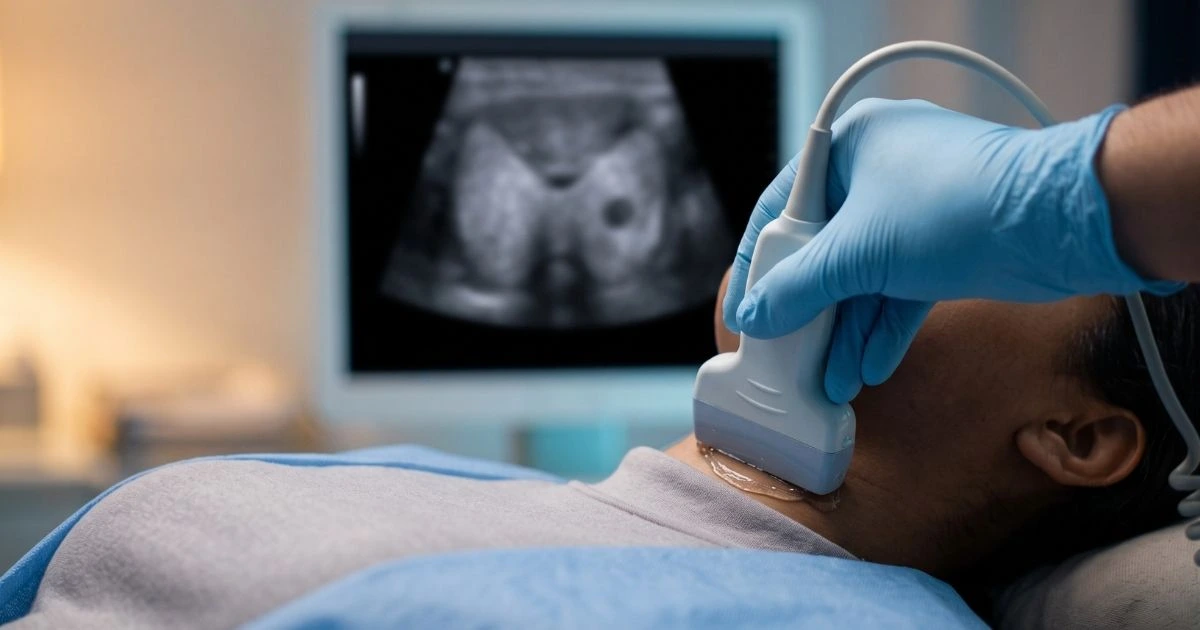
Thyroid nodules are extremely common. They are found so often on scans done for entirely unrelated reasons that radiologists have a term for them — incidentalomas.
The reassuring part is that the great majority are benign. Most people who are told they have a thyroid nodule will never need surgery for it, and many need nothing more than periodic observation.
The task, then, is not to treat every nodule. It is to identify the small minority that need further attention, and to leave the rest alone.
What decides whether it needs attention
Assessment usually rests on three things: your history, an ultrasound, and a blood test of thyroid function.
- Ultrasound features. This does most of the work. Certain appearances — an irregular border, being taller than wide, microcalcifications, marked hypoechogenicity, or suspicious lymph nodes nearby — raise concern. Others are reassuring.
- Size and growth. A nodule that is enlarging over time is watched more carefully than one that has been stable for years.
- Pressure symptoms. Difficulty swallowing, a sensation of tightness, breathlessness when lying flat, or a change in voice.
- Thyroid function. An overactive nodule behaves differently from a non-functioning one and is managed differently.
- Your history. Radiation exposure to the neck, particularly in childhood, and a family history of thyroid cancer both raise the level of concern.
- Rapid growth with hoarseness is the combination that warrants urgent assessment.
What FNAC can and cannot tell you
If the ultrasound or the clinical picture warrants it, the next step is usually FNAC — fine needle aspiration cytology. A very thin needle takes a sample of cells from the nodule, often under ultrasound guidance. It is a quick outpatient procedure and most patients find it far easier than expected.
The result generally falls into one of a few categories: benign, malignant, suspicious, or indeterminate — and sometimes non-diagnostic, meaning too few cells were obtained and the test needs repeating.
"Indeterminate" is not a failed test. It means the cells cannot be confidently classified from cytology alone — because for certain thyroid tumours the distinction depends on features that can only be seen once the whole nodule is examined. In that situation, surgery is sometimes recommended as the way to obtain the answer, not because cancer has been established.
So FNAC is very good at identifying clearly benign and clearly malignant nodules. What it cannot always do is settle the cases in between — and that limitation is inherent to the test, not a fault in how it was performed.
When surgery is usually recommended
- FNAC shows malignancy, or is strongly suspicious of it
- An indeterminate result where the answer cannot be obtained any other way
- Pressure symptoms — difficulty swallowing or breathing, or a nodule pressing on the windpipe
- A large or substernal goitre extending behind the breastbone
- Continued growth under observation, particularly with concerning ultrasound features
- An overactive nodule not controlled by other treatment
- Cosmetic reasons, where a visible swelling significantly affects the patient — a legitimate consideration, discussed on its merits
How much is removed — one lobe or the whole gland — depends on the diagnosis, the size, whether both sides are involved, and what is found at operation.
After thyroid surgery
Two practical consequences are worth understanding before you agree to surgery.
- Hormone replacement. If the whole gland is removed, you will need a daily thyroid hormone tablet for life. It is one tablet each morning, inexpensive and widely available, with periodic blood tests to adjust the dose. If only one lobe is removed, the remaining lobe often produces enough on its own — but not always, so it is monitored.
- Calcium. The parathyroid glands, which control calcium, sit immediately behind the thyroid. They can be temporarily disturbed by surgery, so calcium is checked afterwards and supplements are sometimes needed for a period.
- Voice. The nerves supplying the voice box run very close to the thyroid. Temporary hoarseness can occur; permanent voice change is uncommon in experienced hands but is a recognised risk that should be discussed with you beforehand.
- The scar. It sits in a natural neck crease and usually fades considerably over the following months.
None of this should be discovered after the operation. Ask about all of it beforehand — a proper consent conversation covers each point.
Common questions
Are most thyroid nodules cancerous?
No. The great majority are benign, and many people have nodules discovered incidentally that never require treatment.
Does every nodule need a biopsy?
No. Whether FNAC is needed is decided mainly by the ultrasound appearance, the size, and your clinical history. Many nodules are simply observed.
Is FNAC painful?
It uses a very fine needle and most patients describe it as comparable to a blood test. It is done as an outpatient procedure and takes only a few minutes.
Will I need hormone tablets after surgery?
If the entire thyroid is removed, yes — one tablet daily for life, with periodic blood tests. If only one lobe is removed, the remaining lobe is often sufficient, but your levels will be monitored.
Will my voice change?
Temporary hoarseness can occur because the nerves to the voice box lie very close to the thyroid. Permanent change is uncommon, and this risk should be explained to you before surgery.
Can a nodule be left alone if it is not causing problems?
Often, yes. Nodules that are reassuring on ultrasound and not causing symptoms are commonly kept under observation with periodic scans rather than operated on.
This article is general patient information and does not replace a consultation. If your symptoms are severe or getting worse, please see a doctor rather than relying on it.
Have a question about this?
Bring your reports to a consultation — often one visit settles it.